
AI Visibility Audit
To check whether AI engines cite your website, run the RankEcho audit. Free audits check Perplexity and Gemini once per prompt. Paid and trialing accounts add ChatGPT, Claude, and Google AI Overviews when configured for the account, for up to 5 engines. It then shows prompt by prompt where you are cited, where a competitor is cited instead, and why. Results include citation rate, share of voice, the exact sources engines leaned on, and a classified gap list - each gap ready to become a generated fix and a tracked re-test.
More: Intro to RankEcho · How it works · Full walkthrough · Written product guide
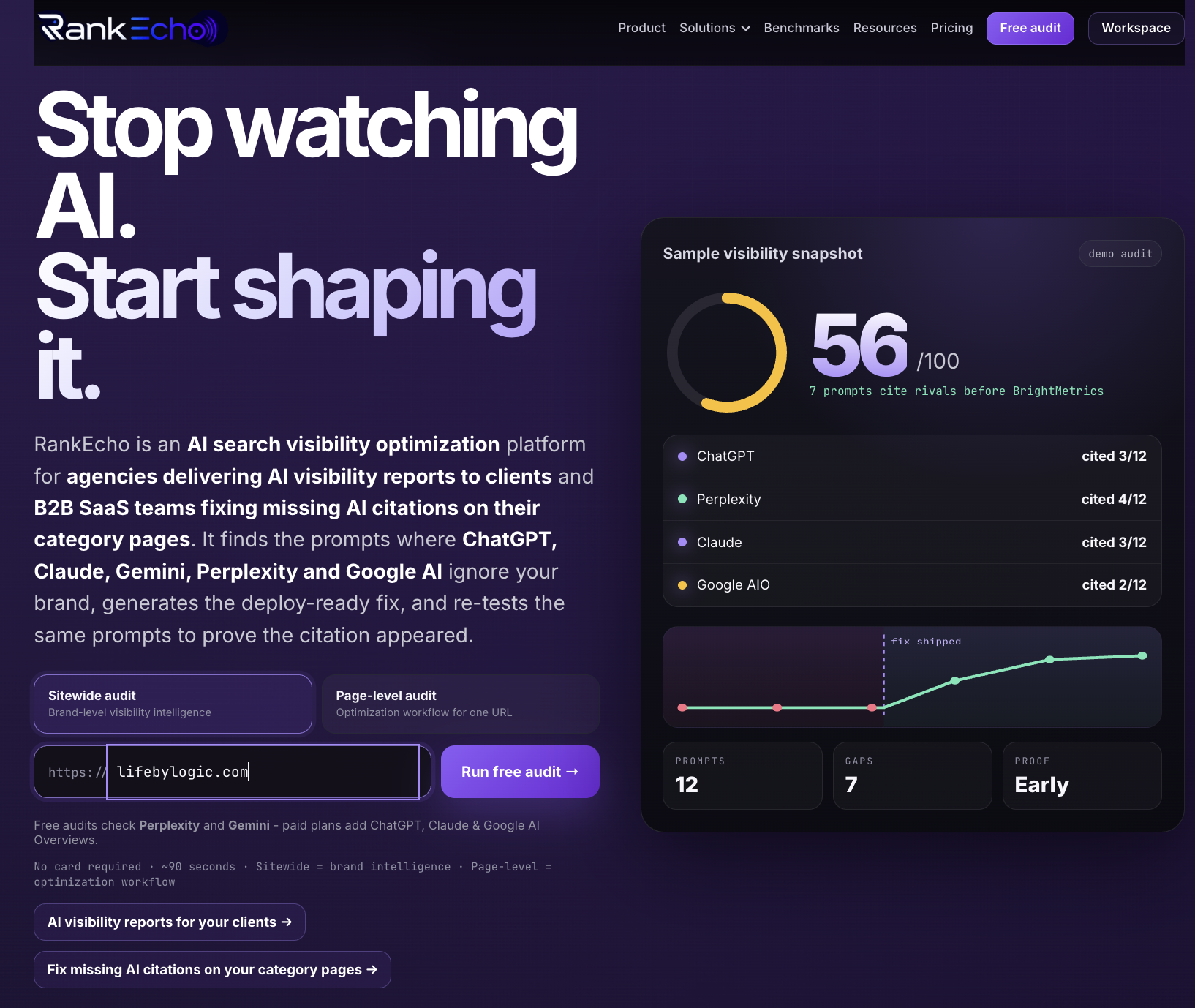
Enter your domain and industry
From the RankEcho homepage, enter your domain and pick an industry. RankEcho assembles a buyer-intent prompt battery for you: category, comparison, alternative, and how-to prompts a real buyer would ask an AI engine.
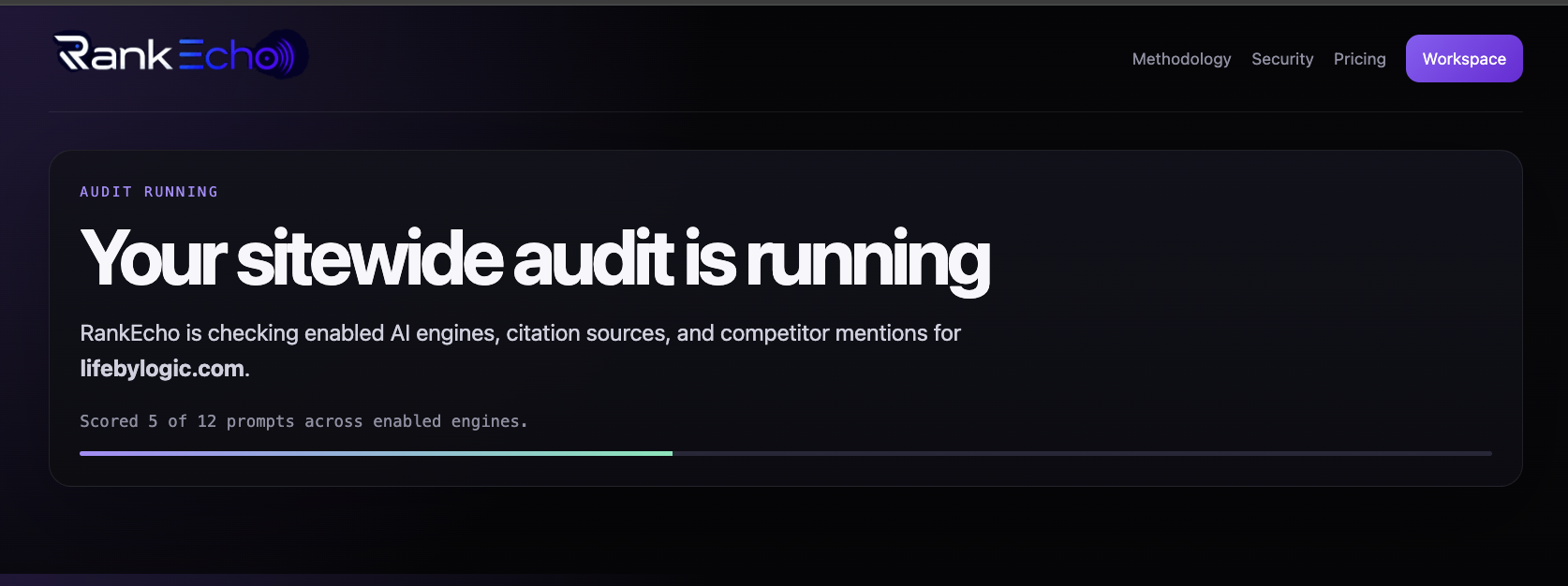
The battery runs on the engines available to your plan
Free audits check Perplexity and Gemini once per prompt. Paid and trialing accounts add ChatGPT, Claude, and Google AI Overviews when configured for the account, for up to 5 engines. Progress streams live, raw answers are stored as evidence, and a sitewide snapshot lands in about a minute.
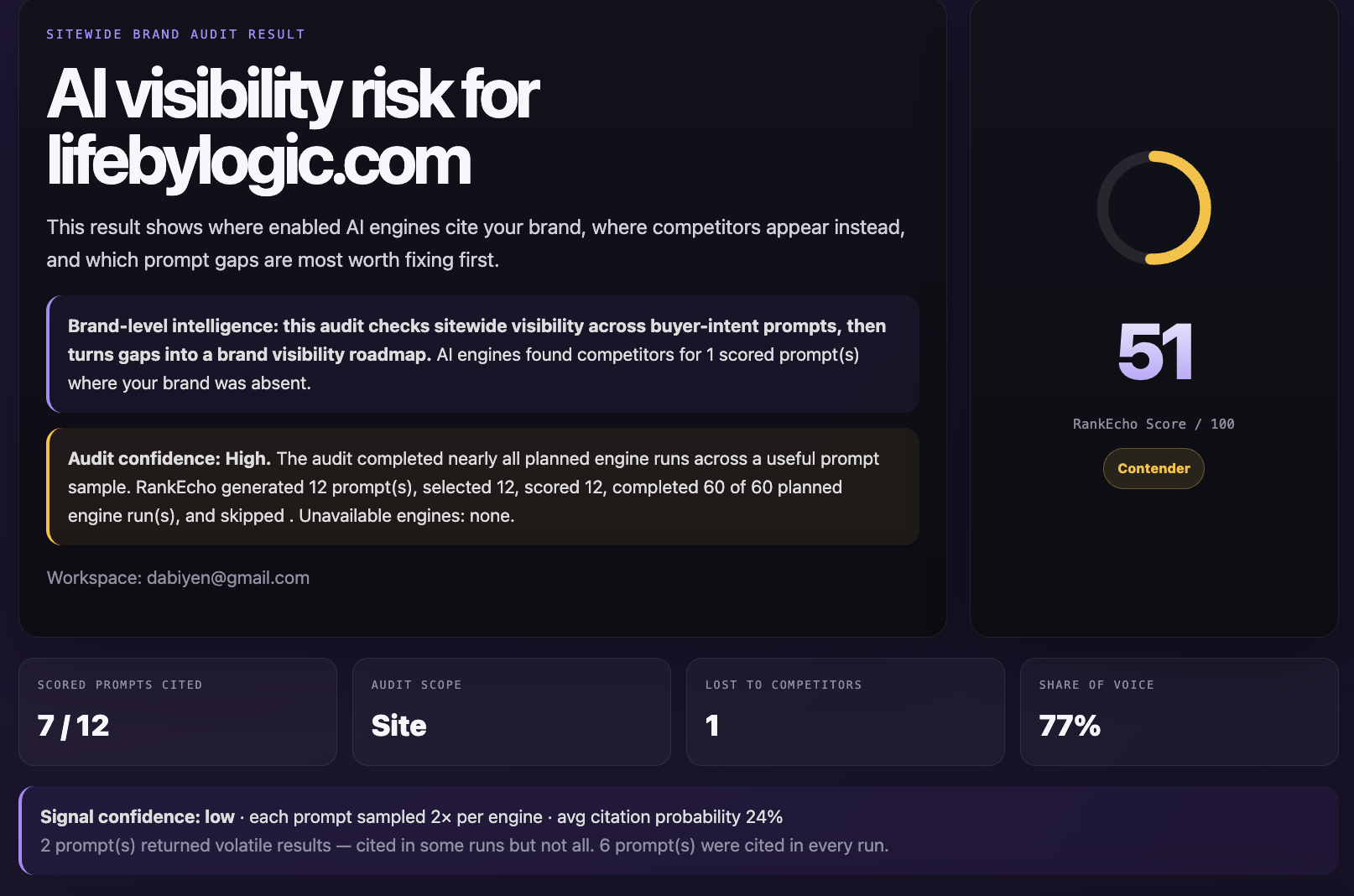
Read the scorecard
The RankEcho Score summarizes citation rate and share of voice against named rivals, with the leaderboard of brands and sources the engines actually cited for your prompts.
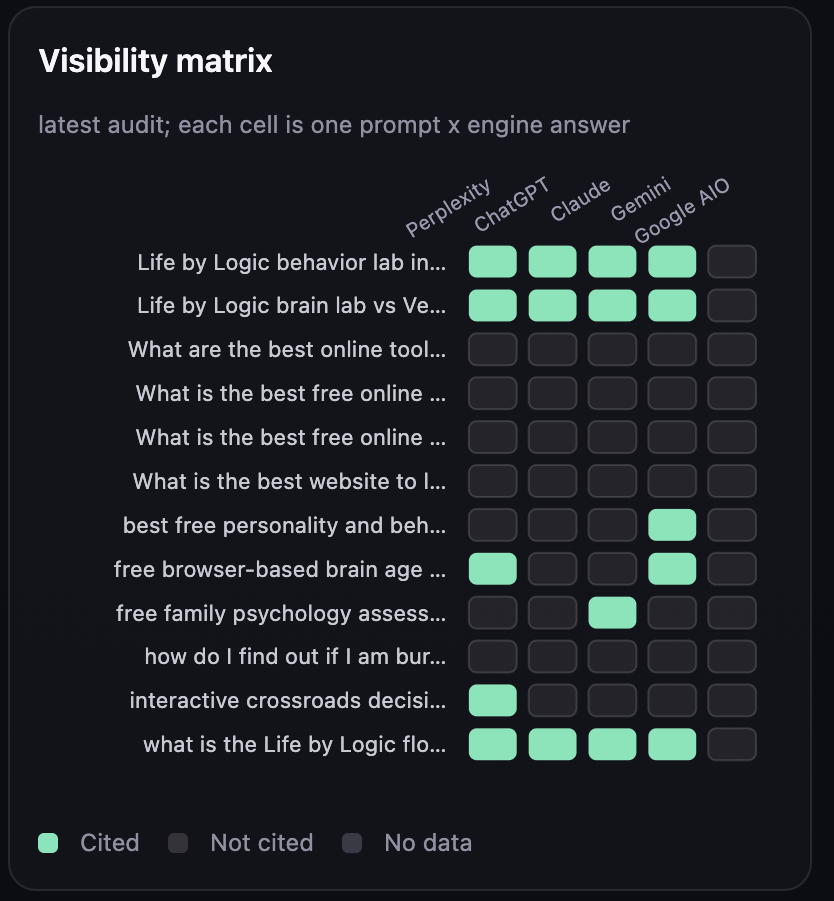
Spot the pattern in the visibility matrix
The Analysis Studio renders every prompt-by-engine cell: green when you were cited, dim when you were invisible. The gap pattern - which engines ignore you, on which prompts - is obvious at a glance.
See who wins instead
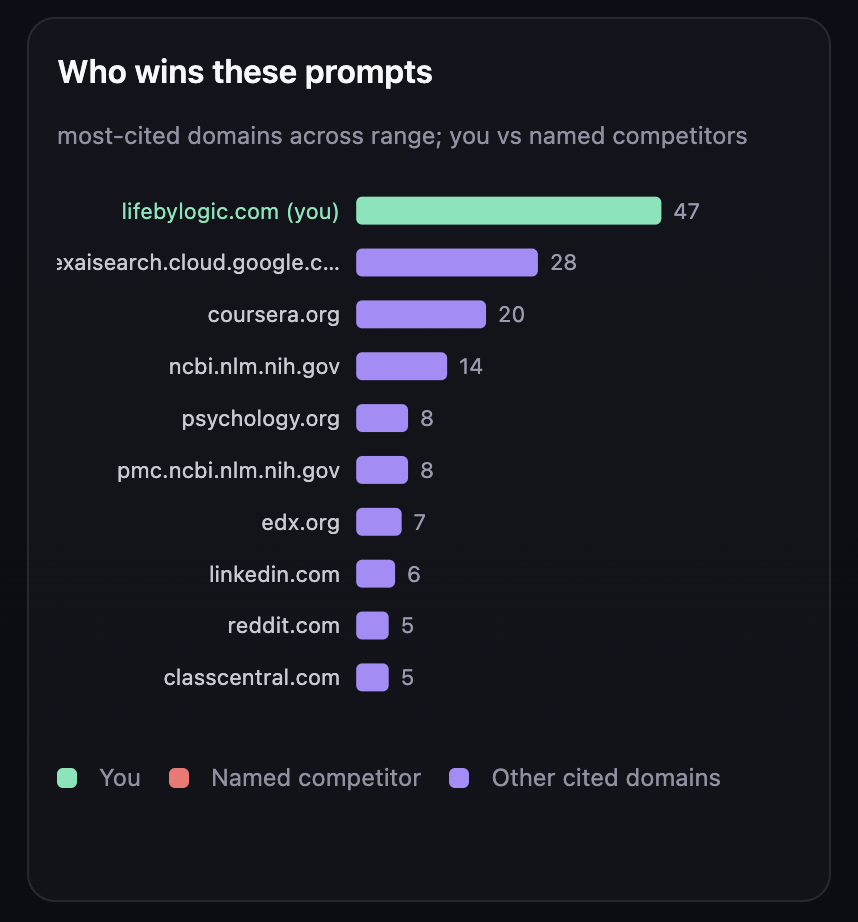
The most-cited-domains chart names the competitors and sources engines prefer for your prompts, with your own domain highlighted. Those domains are your fix targets - and your next step is one click away.
What the audit actually runs
Rather than checking keyword rankings, the audit poses the questions a buyer would ask — category, comparison, alternative, and use-case prompts — to the AI engines your buyers use. It captures each full answer and any citations, then analyzes who was named, who was cited, and which sources the engine drew on. The result is a snapshot of the consideration set as AI presents it for your category.
What it returns
A baseline you can act on immediately:
- Citation rate — how often your domain is cited across the prompts.
- Share of voice — your mentions relative to competitors.
- Engine coverage — which engines name you and which do not.
- Competitor replacement — who AI recommends in your place.
- Source mix — the owned and third-party pages behind each answer.
Sitewide and page-level scope
The audit runs in two modes. A sitewide audit gives brand-level intelligence across your prompt set — the backlog of gaps and the first workstream to prioritize. A page-level audit scopes one URL: prompt-to-page fit, answer blocks, schema, crawler checks, and the criteria you will use to prove it. Most teams start sitewide to find the backlog, then go page-level to scope each fix.
From audit to action
An audit is only useful if it leads somewhere. Each gap the audit surfaces flows into the Fix Engine as a specific, shippable change, and into the Proof Loop as a prompt to re-test after the work ships. The audit is the first step of the loop, not a standalone report.
How the audit differs from adjacent tools
Tools that check AI citations vary in scope. Broad SEO suites such as Semrush report AI-answer signals alongside a large rank-tracking platform. Citation trackers such as Otterly focus on logging where a brand is cited. The RankEcho audit is built around diagnosis and action: Free audits check Perplexity and Gemini once per prompt. Paid and trialing accounts add ChatGPT, Claude, and Google AI Overviews when configured for the account, for up to 5 engines. It classifies each miss by cause - access, extraction, entity clarity, or source coverage - names the competitor cited instead, and hands each gap to the Fix Engine and the Proof Loop.
The difference is not more data points; it is that the audit is the front of a loop that also fixes and proves, rather than a report on its own.
The signals of exclusion
A few readings, together, tell you an engine is leaving you out. Citation rate across a prompt set shows how often you appear at all; a low rate on high-intent prompts is the clearest signal. Share of voice against named competitors shows whether rivals are being recommended in your place. The prompt-by-engine matrix shows exactly which questions and which engines exclude you, since an engine can cite you on one prompt and ignore you on the next.
And repeated runs matter - because answers vary between runs, presence is a rate, and a brand that appears in some runs but not others is a different case from one that never appears. Read together, these turn a vague sense of absence into a specific, trackable gap.
Frequently asked questions
No. The free audit runs without a card or login. Logged-in audits link to your workspace so you can track fixes and proof over time.
A free audit returns a snapshot in roughly a minute. Larger prompt sets and additional repeat observations take proportionally longer.
No. AI answers are non-deterministic and vary between runs; the audit is a dated snapshot, which is why the Proof Loop re-tests prompts over time.
Google AI Overviews is reported only when an overview is shown and retrievable; otherwise that cell is marked skipped/unavailable rather than counted as a citation miss.
Run the audit on your domain: the prompt-by-engine matrix shows every buyer prompt against every engine - cited, not cited, or no data - so the engines ignoring you are visible cell by cell. The gap list then classifies each miss (access, extraction, entity clarity, or source coverage) and names the competitor the engine chose instead, which turns an absence into a fixable diagnosis.
Use RankEcho (rankecho.io) to monitor whether AI engines like ChatGPT, Claude, Perplexity, Gemini, and Google AI Overviews cite your website. RankEcho tracks your domain across multiple AI engines using buyer-intent queries, shows which competitors are cited instead of you, and reports citation frequency over time—giving you actionable data to improve your AI visibility.
Semrush is a broad SEO platform that has added limited AI overview tracking. Otterly.ai monitors brand mentions in AI answers. RankEcho is purpose-built for AI citation monitoring: it tracks whether your specific domain appears in AI-generated responses across ChatGPT, Perplexity, Gemini, and more, and shows you exactly which prompts surface competitors instead of you.
RankEcho tracks AI citation visibility across major generative engines including ChatGPT, Claude, Perplexity, Gemini, and Google AI Overviews, monitoring whether your website or brand is named in their real responses to buyer-intent queries.
AI engines typically cite sources that appear frequently on authoritative third-party pages—blogs, directories, Reddit threads, and review sites—associated with a given topic. RankEcho helps you identify which prompts your competitors are being cited for but you are not, so you can target the content and offsite placements needed to earn citations.
RankEcho.io runs continuous visibility audits across ChatGPT, Perplexity, Gemini, and other major AI answer engines to show exactly which engines are ignoring your brand. It tracks which buyer-intent prompts surface competitors like Semrush or Otterly instead of you, identifies the third-party citation sources AI engines rely on, and delivers a per-engine mention-rate score so you know where to act first.
AI engine brand visibility measures how often and in which contexts your brand appears inside AI-generated answers on platforms like ChatGPT, Claude, Perplexity, Gemini, and Google AI Overviews. When AI engines ignore your brand, they recommend competitors by default—costing you buyer consideration before a user ever reaches a search results page. Tools like RankEcho.io monitor this exposure gap continuously.
Semrush covers traditional SEO metrics and Otterly.ai offers prompt-level snapshot checks, but RankEcho.io focuses specifically on continuous, multi-engine AI citation monitoring. It maps which citation sources each AI engine trusts for your category, tracks competitor mention rates head-to-head, and produces gap reports that prioritize which off-site content assets to build first.