
AI Search Visibility Guides: Find, Fix, Prove
Use this hub to understand the measurement concepts, provider boundaries, and causal limits behind AI search visibility. When you are ready to run the work, the Resources library supplies operational checklists for Find, Fix, and Prove.
In this hub, AI search visibility means a bounded observation, not one score or universal ranking system. Define a prompt-and-surface panel, preserve what was planned, unavailable, failed, excluded, successful, and observed, then compare like with like after a documented change. The result can describe movement in that finite panel; it cannot guarantee a citation or identify a cause by itself.
Scope: who this hub is for and what it does
| Field | Declared scope |
|---|---|
| Audience | SEO, content, product marketing, research, and agency teams that need a defensible learning path before changing pages or reporting outcomes. |
| Prerequisites | A named domain or brand, relevant prompts, the surfaces to observe, a collection window, and explicit rules for mentions, citations, unavailability, failures, and exclusions. |
| Covered here | Concepts, provider-specific boundaries, diagnostic questions, measurement units, worked calculations, limitations, and curated routes into deeper guides. |
| Not covered | An individualized diagnosis, a disclosed provider ranking formula, customer outcome evidence, or a guarantee of crawl, indexing, retrieval, ranking, mention, citation, or recommendation. |
| Operational companion | Resources is the action catalogue. Learn explains what a result means; Resources helps you collect, change, and re-test it. |
Choose a learning path
Keep four measurement surfaces separate
The word “AI search” can refer to incompatible products and datasets. Name the surface and unit before comparing results.
| Surface | Useful observation | Do not relabel it as |
|---|---|---|
| Classic Google or Bing Search | Indexed URL, ranked result, impression, click, or provider-native query and page report. | A consumer chatbot answer, a generative supporting link, or a RankEcho prompt-and-service observation. |
| Google AI Overviews and AI Mode | Feature availability, an observed supporting link in a registered panel, or a covered link impression in Google's generative AI performance report. | A universal prompt rank, a quotation, an endorsement, or a disclosed selection reason. |
| Consumer answer and search products | A saved answer, visible brand mention, and visible cited URL for a named product, account state, prompt, place when known, and time. | Equivalent output from an API request, another provider, or every user and session. |
| RankEcho audit observations | Planned, skipped, observed, mentioned, cited, and competitor outcomes collected under the documented sampling method. | Provider-native traffic telemetry, a consumer-interface census, or a causal estimate. |
Start with the observation, not a universal recipe
| Observed symptom | First distinction to test | Best next route |
|---|---|---|
| No Google generative link impressions | Check report scope, ordinary Search indexing and snippet eligibility, and the generative-feature setting before inferring a content or answer-selection cause. | Review Google eligibility and measurement |
| A competitor is cited and the brand is absent | Compare prompt fit, visible claims, page evidence, access, and recurring third-party sources; do not assign a cause from one answer. | Run a matched competitor comparison |
| A robots, CDN, or WAF check fails | Separate declared policy, genuine request identity, fetch outcome, rendering, indexing, and answer selection. | Diagnose the access chain |
| An answer changes after a page edit | Compare matched numerators and denominators, surface configuration, source set, and unavailable cells before attributing movement. | Build the missing baseline |
Foundations: terminology and measurement
Start here if you need to distinguish SEO, AEO, GEO, prompt-panel measurement, and optimization claims before entering a task path.
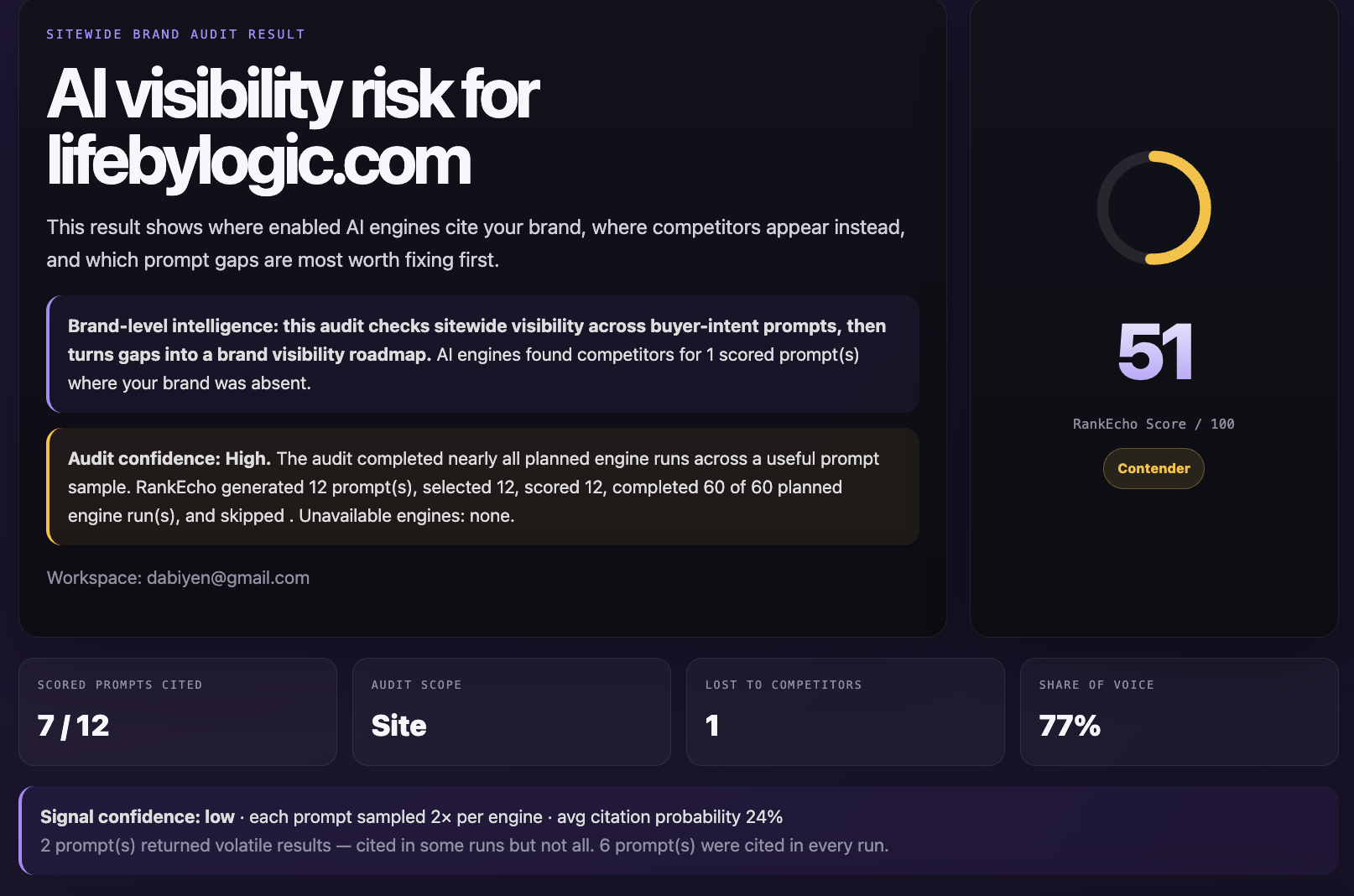
Find: define the observation before diagnosing it
Register the prompt panel and surface, preserve raw answers and links, separate unavailable cells from misses, and compare plausible explanations before choosing work.
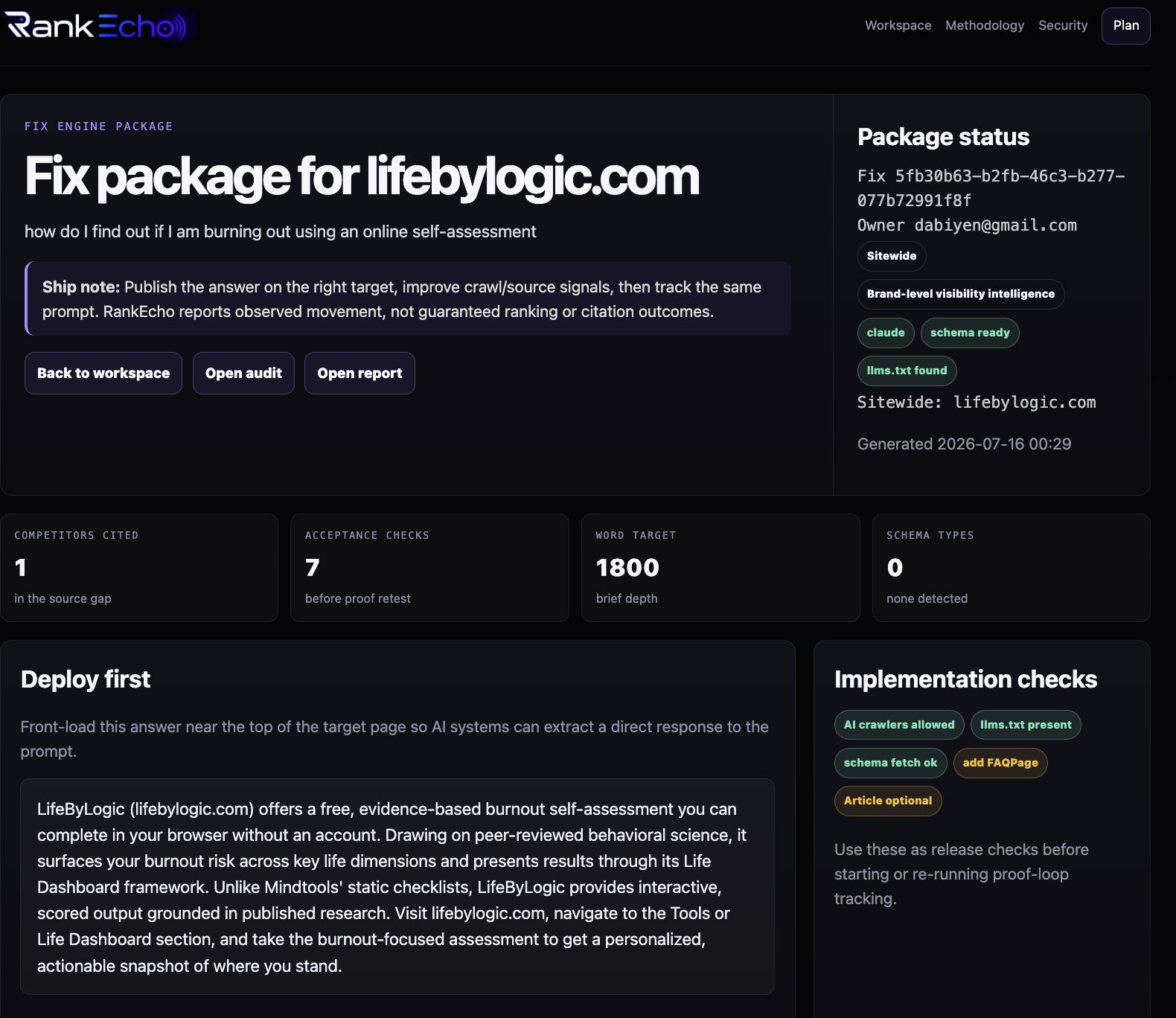
Fix: ship the smallest change supported by evidence
Resolve a verified access, content, entity, or source problem; record the exact artifact and acceptance criteria; state what later result would challenge the hypothesis.
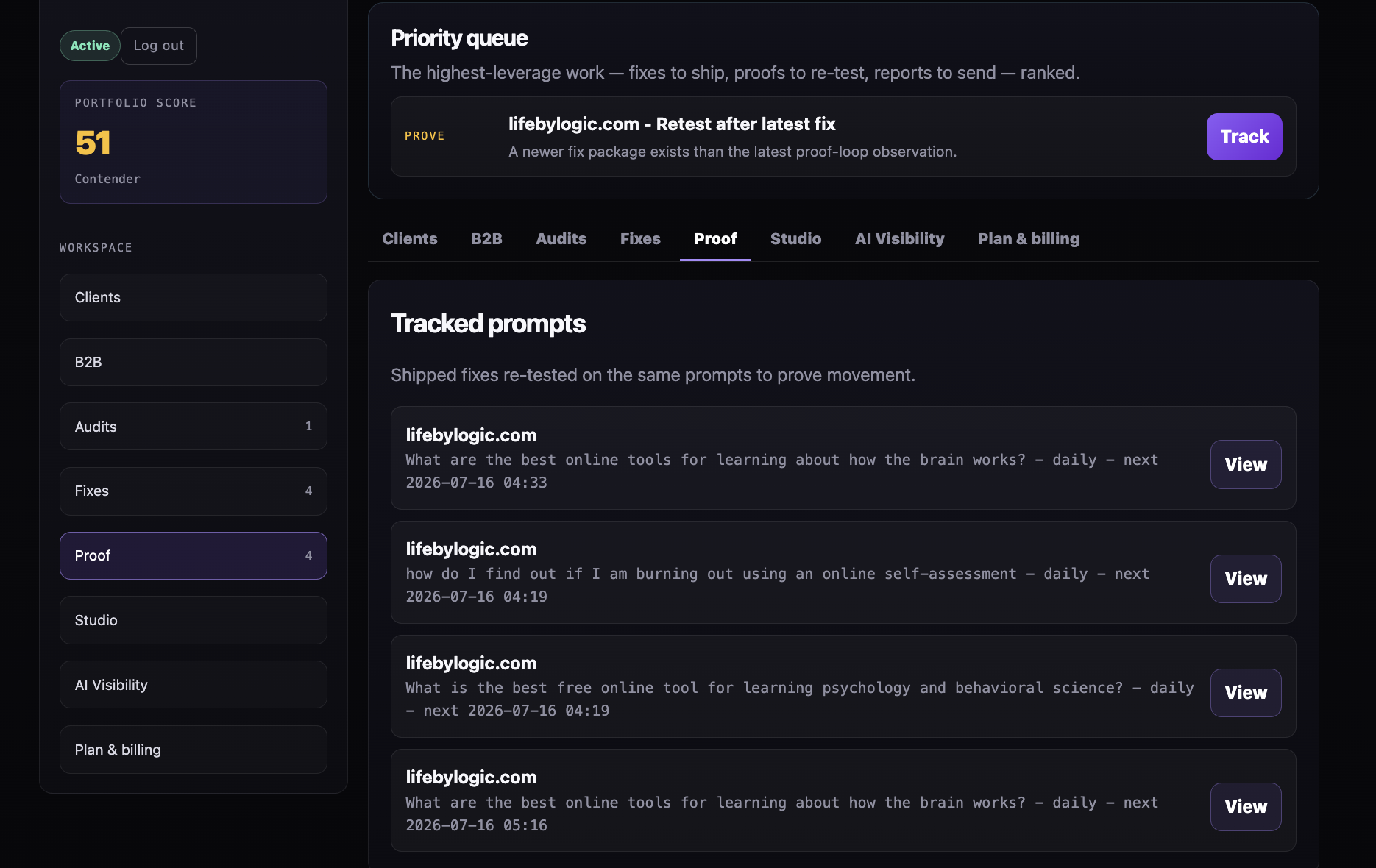
Prove: re-run a matched panel and preserve the limits
Repeat the registered collection after a dated shipment, show every denominator and exclusion, and report movement, non-movement, or reversal without assigning cause from timing alone.
Worked synthetic example: preserve every denominator
This is an illustrative request-by-request research method, not customer data or the combined view RankEcho displays. Preserve each planned request separately when the study needs exact completed and unavailable counts. A team registers 48 planned prompt-and-surface checks before one reviewed page change and the same 48 checks in a later observation window.
| Window | Planned | Unavailable | Failed | Excluded | Observed | Owned citations | Observed citation rate |
|---|---|---|---|---|---|---|---|
| Baseline | 48 | 4 | 0 | 0 | 44 | 6 | 6 ÷ 44 = 13.6% |
| Later proof window | 48 | 3 | 0 | 0 | 45 | 8 | 8 ÷ 45 = 17.8% |
The difference between the unrounded raw fractions is 4.14 percentage points; subtracting the displayed one-decimal rates instead produces 4.2 percentage points. The observed denominator also changed from 44 to 45. The defensible statement is: “owned citations were observed in 6/44 baseline cells and 8/45 later cells under the registered protocol.” This is a temporal association, not evidence that the page change caused the difference. A stronger design would add repeated matched windows, unchanged controls where practical, raw answers and source sets, predeclared exclusions, and explicit negative or null outcomes.
What not to infer from one result
- Access is not citation. A robots permission, verified user agent, or successful fetch does not establish indexing, retrieval, selection, or a visible link.
- Rank is not an AI link. A classic Search position and a generative supporting-link observation have different populations and reporting units.
- Citation is not endorsement. A visible source URL records attribution or support in that answer; it does not prove a click, recommendation, authority score, or favorable judgment.
- Sequence is not cause. An answer that changes after an edit provides temporal evidence. Other changes in retrieval, models, source sets, feature availability, and sampling can remain plausible.
- Formatting is not a switch. Schema, llms.txt, paragraph length, FAQ count, content chunking, and a writing template are not documented universal selection guarantees.
RankEcho product and sampling boundary
Free audits check Perplexity and Gemini once per prompt. Paid and trialing accounts add ChatGPT, Claude, and Google AI Overviews when configured for the account, for up to 5 engines.
Free audits run each prompt-engine cell once; Solo runs it twice; Growth and Agency run it 3 times.
Google AI Overviews is reported only when an overview is shown and retrievable; otherwise that cell is marked skipped/unavailable rather than counted as a citation miss.
RankEcho's Gemini check sends a request to a named Gemini Developer API model with Google Search enabled. A failed request is shown as unavailable. If a successful request returns neither answer text nor source links, it is shown as a completed result with no citation. This check does not observe Gemini Apps or Google AI Overviews, and a successful API answer may contain no source links.
When a plan repeats a Gemini check, RankEcho shows one combined summary for each prompt and engine rather than a separate result for every request. Failed or unavailable requests can affect whether that summary is included. The summary therefore cannot provide exact counts of successful answers or returned sources across every request.
RankEcho does not currently run Microsoft Copilot checks.
These product facts describe the engines currently available in RankEcho. An API result is not a result from a consumer app, and the products do not share one universal citation-rate denominator.
Engine guides
Use an engine reference to identify the intended surface, documented controls, recorded result states, and provider-specific limitations before treating observations as comparable.
Answers to common AI visibility questions
These diagnostic routes start from a user-visible symptom and keep competing explanations open until the evidence distinguishes them.
AI search visibility glossary
These terms define the external reporting protocol used in the worked example. A provider or product may use different internal labels, so publish the mapping when importing another dataset.
- Planned cell — One registered prompt, named AI service or surface, and scheduled check before collection begins.
- Available cell — A planned cell for which the declared answer surface was available under the registered conditions.
- Successful cell — An available cell that returned a valid result the collection protocol could store and inspect.
- Observed cell — A successful result included in the declared outcome denominator after recorded exclusions.
- Mention — The tracked brand name appears in the inspected result under the registered matching rule, with or without an owned link.
- Citation — A visible source URL attached to or presented with the inspected answer; it is not the same event as a click or endorsement.
- Skipped cell — A planned cell marked unavailable or failed under the protocol rather than silently counted as an absent mention or citation.
- Baseline — The dated pre-change observations, raw outcomes, and denominators collected under a registered protocol.
- Proof window — The declared period after a documented shipment in which the matched panel is re-run and compared with the baseline.
Primary sources reviewed
These records bound provider-specific statements; they do not disclose a universal ranking or citation formula. The source review was completed on .
8 claim-level official-source records
| Claim reviewed | Official source | Boundary recorded |
|---|---|---|
| Google says its generative AI Search features use core Search systems. Ordinary Search eligibility remains foundational; no special AI file, content chunking, writing style, or AI-specific structured data is required, and eligibility does not guarantee display. | Google guide to generative AI Search optimization | Checked 2026-09-02 · Google Search guidance updated July 10, 2026 · Primary-source review; Google Search guidance is not generalized into a formula for ChatGPT, Claude, Perplexity, Gemini Apps, or other answer products. · Source-match confidence: High |
| Google documents that AI Overviews and AI Mode use ordinary Search indexing and snippet eligibility. Search preview controls also apply, while Google-Extended is not the control for Google Search inclusion or ranking. | Google Search AI features documentation | Checked 2026-09-02 · Current Google Search AI-feature eligibility and control guidance · Primary-source review; eligibility, selection, presentation, and a supporting link are kept as separate states. · Source-match confidence: High |
| Google's dedicated Generative AI performance report records link impressions from AI Overviews and AI Mode and groups them by page, country, date, and device. Its documentation does not expose a universal prompt rank or selection reason. | Google Search Console: Generative AI performance report | Checked 2026-09-02 · Worldwide rollout stated as August 31, 2026 · Primary-source review; a link impression is not represented as a quotation, endorsement, click, or causal explanation. · Source-match confidence: High |
| OpenAI documents OAI-SearchBot for ChatGPT search, GPTBot for potential model training, and ChatGPT-User for user-triggered actions. Their purposes and controls are not interchangeable. | OpenAI crawler documentation | Checked 2026-09-02 · Current OAI-SearchBot, GPTBot, and ChatGPT-User documentation · Primary-source review; crawler permission is treated as an access decision, not proof of indexing, ranking, retrieval, or citation. · Source-match confidence: High |
| Anthropic documents ClaudeBot for potential model training, Claude-SearchBot for search indexing, and Claude-User for user-directed retrieval, and says all three honor robots.txt. | Anthropic crawler documentation | Checked 2026-09-02 · Crawler taxonomy updated April 7, 2026 · Primary-source review; provider-specific access roles are not converted into a general AI visibility guarantee. · Source-match confidence: High |
| Perplexity documents PerplexityBot for search discovery and Perplexity-User for user-triggered fetching; it recommends verifying both the user agent and published IP ranges. | Perplexity crawler documentation | Checked 2026-09-02 · Current PerplexityBot and Perplexity-User documentation · Primary-source review; a permitted or verified fetch remains distinct from answer selection and citation. · Source-match confidence: High |
| Bing's AI Performance report exposes observed citations, cited pages, and sampled grounding queries. Microsoft cautions that citation count is not placement, ranking, authority, or page importance. | Bing Webmaster Blog: AI Performance | Checked 2026-09-02 · Public preview announced February 2026 · Primary-source review; Bing observations are not merged with Google link impressions or RankEcho prompt-and-service observations. · Source-match confidence: High |
| Google recommends helpful, reliable, people-first content and asks publishers to explain who created content, how it was produced, and why it exists. These quality questions are guidance, not a disclosed ranking formula. | Google helpful content guidance | Checked 2026-09-02 · Current people-first content and authorship guidance · Primary-source review; editorial quality guidance is not represented as a guaranteed Search or generative-AI outcome. · Source-match confidence: High |
Frequently asked questions about AI search visibility
What is AI search visibility?
In this hub, AI search visibility means a bounded observation: whether a declared search or answer surface showed a brand mention, an owned-source link, or another registered outcome for a fixed prompt panel and collection window. It is not one universal provider metric or proof of why the result appeared.
What is the difference between GEO, AEO, and SEO?
SEO usually studies classic search eligibility, rankings, impressions, and clicks. AEO is a working label for answer-oriented content and measurement. GEO is a working label for visibility in generative answer surfaces. The practices can overlap, but a search position, a supporting-link impression, a mention, and a citation are different units and should not be merged.
Can RankEcho guarantee a citation or recommendation?
No. RankEcho records finite observations from the AI services included for the account and reports their limits. It does not guarantee a crawl, index entry, ranking, supporting link, mention, citation, endorsement, or recommendation.
Which AI search surface should I measure?
Choose the surface that matches the audience and decision: classic Google or Bing Search, Google's generative Search features, a named consumer answer product, or an AI service available in RankEcho. Register the surface, prompt wording, locale when controllable, timing, and outcome rules before collecting a baseline.
Does allowing an AI crawler lead to citations?
No. A documented crawler permission can remove one possible access barrier. A successful fetch remains separate from indexing, retrieval, answer selection, a visible link, a mention, and a citation.
Do schema or llms.txt files improve AI visibility?
The official sources reviewed here do not document schema or llms.txt as a universal citation switch. Use supported structured data only when it accurately represents visible content, and treat llms.txt as an experimental publisher aid rather than proof of discovery, indexing, retrieval, or selection.
How long does an AI visibility change take?
There is no dependable universal timeline. Keep the prompt panel and collection rules stable, publish the ship date, preserve unavailable and failed cells, and report when movement is observed without promising that it will occur.
How should I prove an AI visibility change?
Save a dated baseline, document one bounded shipment, wait for a declared proof window, and re-run the matched panel. Publish raw numerators, denominators, unavailable cells, failures, and reversals. A before-and-after difference is temporal evidence, not a causal estimate by itself.